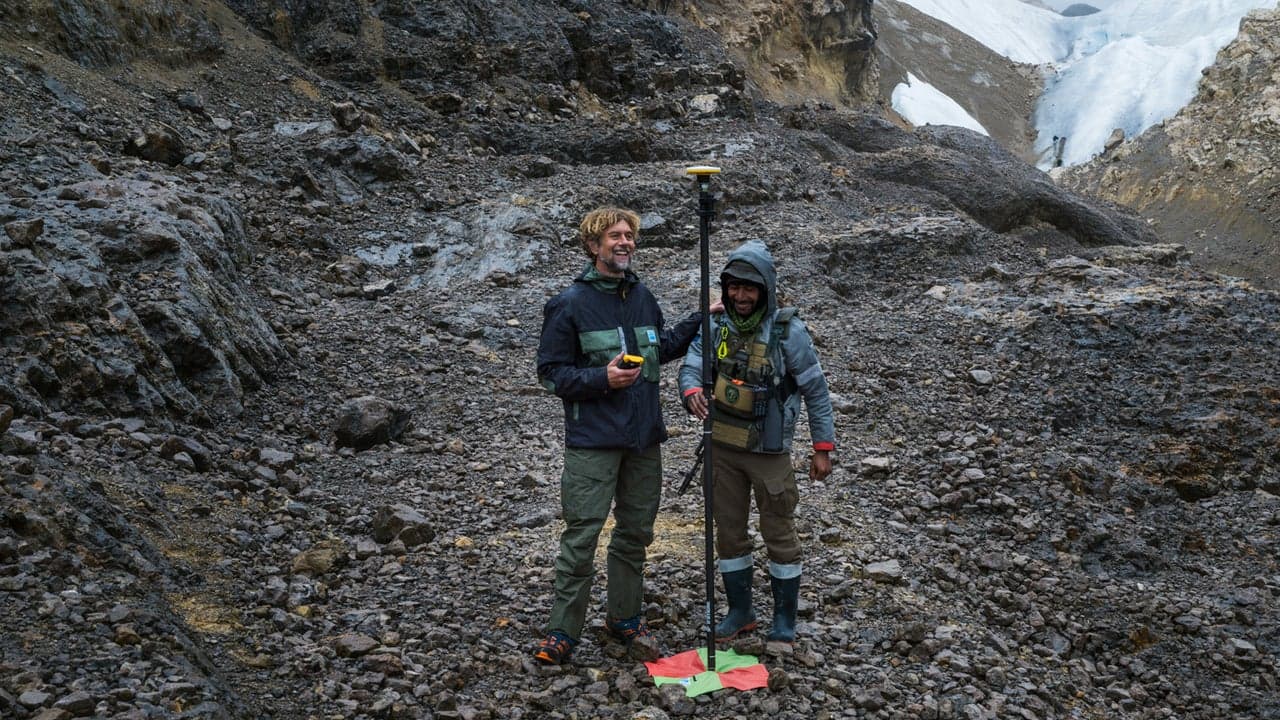
Photo via Fast Company
Explorer and scientist Klaus Thymann recently undertook a high-risk expedition to Indonesia's remote Puncak Jaya mountain to create detailed 3D models of the world's last tropical glaciers. According to Fast Company, the glaciers—located in a restricted area of Papua Province where travel is officially banned due to civil unrest—are vanishing at an alarming rate. Thymann estimates these ice formations could disappear entirely within the next decade, making his documentation effort a race against time.
The scale of glacial loss in this region is staggering. Between 1980 and 2024, the area lost 97% of its ice cover, shrinking from roughly twice the size of Central Park to an area smaller than Grand Central Station. Four of the original six glaciers have already disappeared completely. Thymann's work provides a stark visual record of how climate change accelerates ice melt even in tropical regions where glaciers are unexpected geographical features.
To capture the glacier's current state with centimeter-level precision, Thymann employed drone photography combined with specialized geolocation software from Trimble, a technology company specializing in spatial data solutions. The heavy cloud cover—the region receives rain roughly 300 days annually—makes traditional satellite mapping unreliable, making drone-based 3D modeling the most accurate approach available. This technical approach demonstrates how specialized equipment can overcome environmental obstacles to gather critical scientific data.
The resulting open-source dataset serves dual purposes: it provides researchers with baseline ecosystem data for tracking environmental changes, while also preserving a cultural record. Local communities call these formations the 'eternity' glaciers, and Thymann's 3D models ensure future generations can visualize what existed before climate change fundamentally altered the landscape. This work exemplifies how technology and environmental stewardship intersect to document our changing world.