Photo via Zerohedge
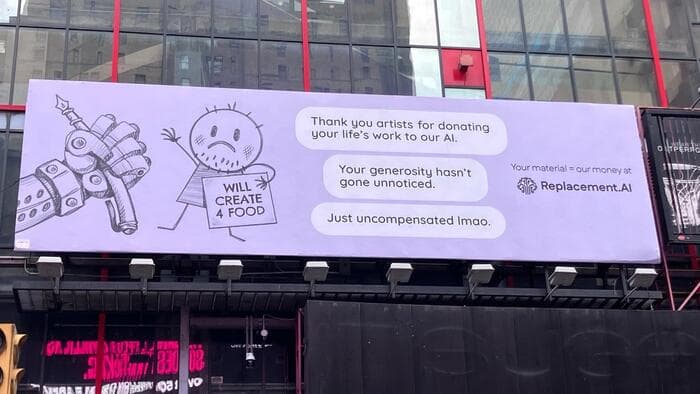
The artificial intelligence revolution is forcing American businesses to confront a fundamental question: Is AI a tool that enhances human productivity, or will it replace workers at scale? Two competing billboard campaigns in New York City—one promoting AI employee replacement and another warning of creative work exploitation—exemplify the uncertainty gripping business leaders nationwide. For Dalton employers, particularly those in carpet manufacturing, logistics, and light industrial sectors, understanding this debate is essential to strategic planning.
The numbers tell competing stories. According to various forecasts, AI could displace between 92 million and 300 million jobs globally by 2030, though some economists argue new positions will emerge to offset losses. Meanwhile, major corporations including Amazon and Microsoft have announced significant workforce reductions tied to AI efficiency gains. For Dalton-area companies evaluating automation investments, these mixed signals underscore the importance of developing workforce transition strategies rather than assuming either mass displacement or job growth will automatically occur.
Beyond employment displacement, a critical issue emerging is intellectual property rights. Major AI developers have faced lawsuits from artists, writers, journalists, and media organizations alleging that copyrighted content was used without permission or compensation to train AI systems. According to court filings, OpenAI itself acknowledged that training modern AI models would be "impossible" without using copyrighted materials. For Dalton businesses creating proprietary content, trade secrets, or original designs, this legal uncertainty raises questions about how their intellectual assets might be used by competitors leveraging AI technology.
As Dalton's business community navigates this transition, the practical challenge is neither panic nor complacency. Instead, forward-thinking employers should assess which roles AI can genuinely enhance versus which require human judgment, creativity, and customer relationships. The most successful companies will likely be those treating AI as a productivity enhancement tool while investing in workforce development, protecting intellectual property, and maintaining the local talent base that has built Dalton's reputation across multiple industries.